How Spreadsheeto reported $20,000-plus from a post-pitch survey
Spreadsheeto asked course non-buyers what held them back, followed up by answer, and reported more than $20,000 in revenue—while learning where the pitch needed work.

Key takeaways
- A post-pitch survey asks non-buyers what held them back after an offer closes. It is not a post-purchase satisfaction survey.
- Spreadsheeto reported that about 8% of survey respondents eventually bought and attributed more than $20,000 in post-pitch revenue to the flow.
- The results describe self-selected respondents choosing from five supplied answers. They diagnose objections worth investigating; they do not prove why every non-buyer declined or what would have happened without the follow-up.
- Every answer should change the next message, proof, offer, or route. If it changes nothing, do not ask for it.
What Spreadsheeto asked after the pitch
Spreadsheeto waited until its evergreen promotion had ended, excluded buyers, and sent non-buyers a plain email from co-founder Kasper Langmann. The central question was direct: “I would like to know why you didn’t buy Zero to Hero?”
The email asked each reader to click the answer that best represented their decision:
- “I’m interested, but I missed the deadline.”
- “I don’t have the time to do the work.”
- “It’s too expensive.”
- “I don’t know if you can help me learn Excel.”
- “I don’t want to advance my career.”
Each answer was a link. One click recorded the stated objection and moved the subscriber into the matching follow-up. There was no separate questionnaire to load, no score to calculate, and no request for feedback before the reader understood the product.
The original email is useful evidence because it shows exactly what people saw. This is a historical screenshot of that message, not a current RightMessage interface:
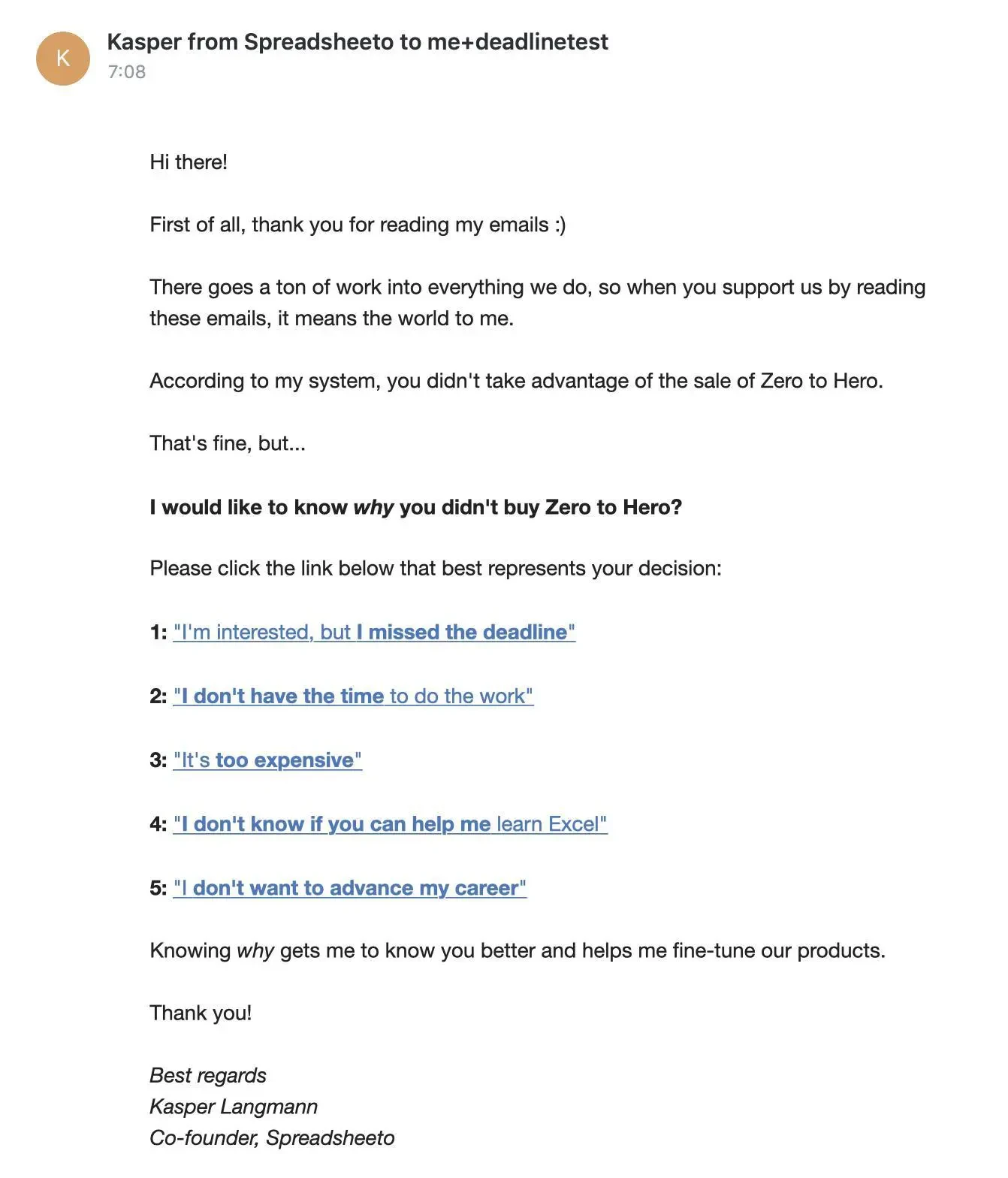
This timing makes the survey different from a post-purchase survey. Spreadsheeto was not asking customers to rate a course they had bought. It was asking qualified non-buyers about a decision they had just made, while the offer and its objections were still fresh.
What the reported numbers actually say
Brennan later documented the cohort results in his book This Is Personal. The two percentages in each row have different denominators: the response share is a portion of survey respondents, while the purchase rate is a portion of the people who chose that answer.
| Stated reason | Share of survey respondents | Reported purchase rate after the re-offer |
|---|---|---|
| Missed the deadline | 22% | 18.5% |
| Did not have time | 21% | 4.5% |
| Too expensive | 48% | 6% |
| Unsure Spreadsheeto could help | 6% | 2% |
| Did not want to advance their career | 3% | Virtually none |
Overall, Spreadsheeto reported that about 8% of survey respondents eventually bought. A RightMessage workshop hosted by Copyblogger summarized the campaign as more than $20,000 in additional post-pitch revenue.
The missed-deadline path converted best in the reported data. That makes practical sense as a follow-up opportunity: those subscribers said they were interested, and the obstacle was timing rather than fit. Spreadsheeto gave them a 24-hour chance to enroll.
Price was the most frequently selected answer, at 48% of respondents, but its reported re-offer purchase rate was 6%. That did not mean “lower the price” was automatically the right conclusion. It meant the team had a large value question to investigate: Was the outcome unclear? Did the pitch connect stronger Excel skills to a promotion, a raise, or a better job? Did some subscribers simply lack the budget at that moment?
A post-pitch survey diagnoses; it does not prove causation
This case study is easy to overstate in two ways.
First, survey respondents are not the same as all non-buyers. People willing to click an answer may be more engaged than people who ignore the email. So “48% selected price” means 48% of respondents selected that supplied option—not that price caused 48% of every lost sale.
Second, the answer list shapes the result. The Pew Research Center’s guidance on writing survey questions notes that wording and answer order can affect responses, and that closed-ended categories should cover reasonable answers without overlapping. Spreadsheeto’s five options were short and concrete, but a subscriber with two objections still had to choose one. Someone whose reason was not listed had no visible “other” path.
Treat each click as a useful statement with a scope:
- It describes this person’s stated objection to this offer at this moment.
- It suggests which follow-up is most likely to help.
- In aggregate, it identifies themes for more research.
- It does not turn someone into a permanent “price objection” or “trust objection” persona.
The revenue needs the same care. Spreadsheeto could count purchases that happened through the follow-up paths and report the revenue attached to them. Without a holdout group, however, the case does not establish how many of those buyers would have purchased later anyway. The honest conclusion is still commercially useful: the flow generated attributable post-pitch purchases and exposed specific objections. It is not a universal promise that the same survey will create the same lift elsewhere.
Turn each answer into a genuinely different follow-up
The survey only earns the click if the answer changes what happens next.
For Spreadsheeto, the missed-deadline group could receive a genuine, time-limited re-offer. Someone worried about time needed a realistic picture of the workload, course access, and pace—not another countdown timer. Someone choosing price needed a clearer case for the value of the outcome, or a more suitable offer if one existed. Someone unsure Spreadsheeto could help needed relevant proof: a sample lesson, student example, syllabus, or the actual terms of a guarantee. And someone who did not want the career outcome should not be chased with increasingly aggressive versions of the same pitch.
That is the practical standard: responding to an objection does not always mean overcoming it. Sometimes the most relevant route is a different resource, a lower-commitment product, or no pitch at all.
To build the mechanism:
- Send the question only to people who received the pitch and did not buy.
- Use tracked links or a short quiz or survey flow to record one answer, then acknowledge the click.
- Keep the answer scoped to the offer and decision. A field such as “Zero to Hero non-buyer reason” is safer than labeling the whole person “price sensitive.”
- Change both the email and the destination page. A time-focused email that lands on the same generic sales page breaks the conversation.
- Stop or redirect the sequence when someone purchases, changes their answer, or reaches a path where the offer is not a fit.
You do not need five complicated automations on day one. Start with the answers that produce meaningfully different messages. If “too expensive” and “not sure it will help” both lead to the same generic email, the distinction is not doing useful work yet.
Measure the recovery and improve the next pitch
Track the path from invitation to purchase without collapsing everything into one conversion rate:
- How many eligible non-buyers received the survey?
- What percentage answered?
- What share of respondents chose each reason?
- What percentage of each response group bought?
- How much revenue, refund activity, and support load came from each path?
Keep the denominators beside the numbers. A high purchase rate among a small response group and a low purchase rate among a large one create different priorities. If you want to measure incremental impact rather than attributable purchases, keep a comparable holdout that receives the normal post-pitch treatment.
The longer-term value is the feedback loop. Repeated price responses might lead you to clarify the economic payoff in the next pitch. Repeated time concerns might lead to a better workload explanation. Weak trust-path purchases might point to missing proof—or show that the offer is reaching people it cannot help. After changing the pitch, ask consistently enough to see whether the response pattern changes; a rewritten question or reordered list can make a clean comparison impossible.
Spreadsheeto’s lesson is not “send a survey and make $20,000.” It is simpler and more durable: ask qualified non-buyers a question you are prepared to act on, make the next message agree with their answer, and learn from both the replies and the purchases.
If you want to put that into practice, start with one short RightMessage survey flow, then use the offer-funnel model to keep the subscriber’s next email and on-site offer aligned.
Common questions
Frequently asked questions
What is a post-pitch survey?+
A post-pitch survey asks people who saw an offer but did not buy what held them back. The useful version records the answer and changes the next follow-up, rather than collecting feedback that sits in a report.
How is a post-pitch survey different from a post-purchase survey?+
A post-pitch survey goes to non-buyers after a promotion or sales sequence. A post-purchase survey goes to customers after they buy and usually asks about the purchase or product experience. Mixing the two stages produces the wrong questions and follow-up.
When should you send a post-pitch survey?+
Send it soon enough that the offer and decision are still fresh, after the promotion has genuinely ended. Suppress purchasers and anyone who did not meaningfully receive the pitch, and state clearly why you are asking.
How many answers should a non-buyer survey include?+
Use a short set of distinct answers that covers the reasonable objections you can act on. Spreadsheeto used five. If your list cannot cover the likely reasons without forcing a poor fit, add an “other” path or do open-ended research first.
Do survey answers prove why people did not buy?+
No. Respondents are self-selected, wording and answer order can influence a choice, and one selected reason may hide several concerns. Treat the distribution as a diagnosis that guides follow-up and further research, not as a causal measurement of every non-buyer.
Should you reopen the offer for everyone who answers?+
No. Reopening can make sense for someone who says they missed a real deadline, but a time, value, trust, or fit objection needs a different response—and sometimes the honest next step is no sale at all.